
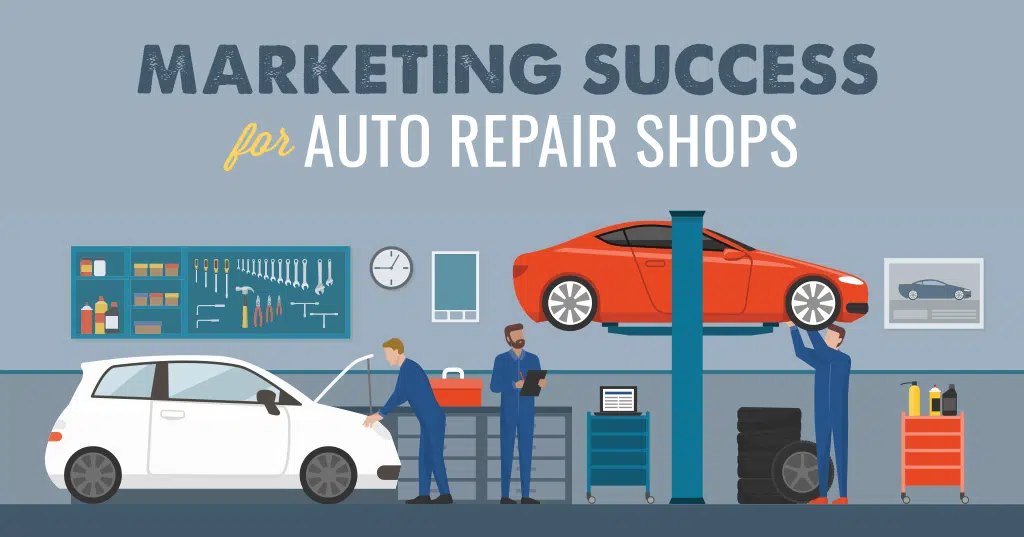
In today’s 24/7/365 always-on digital landscape, growing your auto repair business isn’t about spending thousands on billboards or TV commercials. It’s about building a strong online presence.
Think about it: When potential customers need a car battery replacement or an oil change, they look online to find an auto repair shop for the project. If you’re not marketing effectively, your prospects won’t find your business—and they’ll turn straight to the competition.
Still not convinced that digital marketing is necessary? Let’s look at the numbers. According to 2022 marketing statistics, 88 percent of mobile users who search for a store on Google Maps visit a related store within a week, while 28 percent of “nearby” or “near me” searches end in a purchase. In other words, if you’re not on the first page of Google search results, you could be missing out on thousands of potential leads.
Digital marketing isn’t just about building brand awareness among potential customers in your service area. It also holds unrivaled potential for building relationships with prospects, boosting customer loyalty, and showcasing your brand values. With an impactful strategy, you can keep the phone ringing and your appointment book full—all while maximizing your marketing ROI.
Ready to fuel your business growth with a steady stream of leads?
Marketing is all about goals. In fact, research shows that marketers who set goals are 376 percent more likely to report success than those who don’t. Yes, you read that right.
Without goals, we aimlessly drift from task to task without a clear understanding of how our marketing efforts really make a difference to our bottom line. With clear goals in place, you can start constructing an effective strategy to achieve them.
Goals can be a powerful tool to grow your auto repair shop, but not all goals are created equal. So, what’s the secret to goal-setting success? Make sure they’re SMART: specific, measurable, attainable, relevant, and time-bound.
This way, you’ll be able to realistically evaluate your goals and pinpoint exactly what actions you need to take to grow your business. Here’s how to get started.
The first step is to get specific. Think about your goal in quantifiable terms and define what actions you need to take to get there.
When you set a specific goal, you’ll answer the “w” questions like who can help accomplish your goals, what your goals are, when you want to meet your goals, which goals are important, and why your goals exist.
Example: We’re going to increase leads.
To measure your goal, you need to determine which metrics to track. Here, you’ll also want to consider what actions you need to implement to measure progress toward your goal.
Depending on your goal, this might take the form of tracking time to build your lead generation campaign—or using call tracking metrics to measure leads from social media. If you’ve run marketing campaigns in the past, lean on historical data to inform your next strategy.
Example: We’re going to increase leads by 50 percent.
Now, you need to make your goal realistic and attainable. Consider how long it’ll take, potential obstacles, and measurement methods to track your progress.
Remember: You’ll need a long-term approach to keep the phone ringing, but our clients tell us that digital marketing is well worth the time and effort. If you don’t have time to sacrifice away from the field, an experienced partner can handle the marketing tasks for you so you can focus on what’s most important: running your business.
Example: We’re going to increase leads by 25 percent using a lead generation campaign on Facebook.
The next step is to ensure your goal is relevant to your business. When a goal is relevant, it directly relates to an aspect of your business you want to improve. Any actions you take to achieve that goal should directly influence your progress.
Example: We’re going to increase leads by 25 percent using a lead generation campaign on Facebook to build relationships with local homeowners.
Finally, create a timeline with target dates for small and big tasks. Ask yourself whether you’re working toward a short- or long-term goal. From there, set a schedule to meet deadlines and achieve your objective.
Your timeline should be realistic, and it should allow for plenty of opportunity to tweak your strategy to maximize your ROI. To boost your marketing success, schedule regular check-ins to monitor your progress. The frequency of your check-ins will vary depending on your specific goal, but you shouldn’t kick off a marketing campaign without tracking your performance along the way.
Example: We’re going to increase leads by 25 percent by the end of the second quarter using a lead generation campaign on Facebook to build relationships with local homeowners.
Congratulations! You’ve created SMART goals for your business—but your marketing strategy isn’t complete just yet. Now, it’s time to conduct some research so you can see exactly what you’re up against.
In addition to your current marketing challenges, keep future possibilities in mind. After all, you don’t want to waste valuable time, money, and resources to completely revamp your auto repair marketing strategy every single time you hit a bump in the road. That’s why you need to conduct a SWOT analysis.
A SWOT analysis identifies your strengths, weaknesses, opportunities, and threats. It helps you pinpoint any internal and external factors that can impact your marketing success.
Your strengths set you apart from the competition (a loyal customer base, strong social media presence), while your weaknesses can serve as potential areas of improvement (low conversion rates, a weak brand). Opportunities are factors that will give you a competitive advantage (tapping into new marketing channels), and threats are factors that can harm your business (increasing local competition).
So, how can you conduct a SWOT analysis on your marketing strategy? To paint a clear picture of your auto repair business, start by combining your external and internal data. Then, ask yourself the following questions.
Before you start developing your marketing strategy, you need to figure out who you’re marketing to. At the end of the day, the success of your auto repair shop lies in the hands of your customers—and they expect you to create targeted, personalized experiences to grab their attention in a sea of brands and advertisers.
Your target audience is a specific group of customers who are most likely to purchase your auto repair services. The group can be dictated by age range, gender, income, location, interests, and various other factors. No matter what your target audience looks like, they need to be the center of your marketing campaigns.
So, how do you determine your target audience? Start by looking at your past customers. How old are they? Where do they live? What are they interested in? To learn more about them, engage them on social media or distribute customer surveys via email.
Next, conduct some market research for your industry and local market. Take a look at your competitors to see where they’re focusing their efforts. It’s also worth taking the time to define who your target audience isn’t.
Once you’ve gained a clear picture of your ideal buyer, you can make more informed decisions about your marketing strategy and brand messaging. Then, you can leverage your customer data to build buyer personas. This way, you can market to a laser-focused market that’s already interested in your products and services.
Your buyer personas should be more than just a vague list of demographics. Utilize your data to create profiles of fully formed people with an age range, income, education level, interests, buying motivations, and job title. Perfecting your buyer personas won’t happen overnight, but it can make all the difference in your marketing, advertising, and content creation efforts.
Now that you’ve identified your strengths and researched your target audience, it’s time to create an impactful value proposition. Your value proposition should capitalize on the strengths you identified in your SWOT analysis.
At its core, your value proposition is the value that your auto repair business promises to deliver to your prospects if they hire your company. It’s the core of your company’s competitive advantage. Why? Because it shows prospects exactly why they should choose you over the competition.
Your value proposition should address your prospects’ pain points, resonate with them, and differentiate your brand. It should dive into the problems you want to solve for customers, and what makes your services the best solution.
Of course, finding your value proposition is easier said than done. Here’s how to identify your brand’s value and leverage your value proposition to further your marketing efforts.
As a business owner, you might think that customers can deduce the benefits of your services just by visiting your website—but most of your prospects aren’t auto repair experts. To effectively market your products and services, you need to help prospects realize the benefits of your company.
But how do you communicate the benefits of your auto repair services? First, help prospects realize the “pain” of ignoring their current situation. Let’s say they’re driving around with a cracked windshield—or their air conditioner isn’t working properly. Your goal is to tap into the emotional side of their pain points so you can position your business as the best solution.
Whether you’re writing landing pages, blogs, or social media posts, make your value proposition stand out as much as possible. Celebrate the things that set your brand apart—but keep your copy fresh and punchy.
Here, your goal is to showcase the benefits of your business in as few words as possible to show prospects exactly why you’re unique and valuable. Remember: You want to captivate your prospects and capture their attention instead of sounding like every other auto repair shop in town.
It might seem counterintuitive, but competition is a good thing. Even though your competitors are bound to take some customers away from you, tracking their marketing moves can help you compete, find loopholes in their strategy, and gain the competitive edge you need to speed into first place.
Of course, you’ll need a standout product or service to outperform the competition, but you’ll also need to market that product or service to your prospects. To win at auto repair marketing, you need to figure out which strategies work—and which don’t. That’s where spying on the competition can help steer you in the right direction.
Whether you’re new to digital marketing or updating your current strategy, here’s how to start spying on the competition.
After identifying your biggest local competitors, follow their accounts on social media, sign up for their email newsletters, and check out their blogs. In most cases, businesses will announce new products, advertise discounts, and publish other news, so you can gain some insight into what they’re doing and what they’re planning to do.
To simplify the process, consider investing in a social listening tool. Social listening tools make it easy to monitor the entire web, so you can keep up with social media, blogs, forums, news sites, and more.
With social listening, you’ll be able to see whenever your competitors are mentioned online. This information can help you benchmark your auto repair shop against the competition. It’s also a great way to paint a clear picture of their overall strategy—and the results they’re getting in return.
Generating website traffic is easier said than done. You need to experiment with different tactics and continually update your keyword strategy—all while competing with countless other businesses to get in front of the same audience.
In this case, monitoring your competitors’ SEO strategy can shed some light on how they’re driving traffic. Even though you’re going to take a different approach from the competition, researching their strategy using keyword analysis tools can give you some inspiration to improve your own.
Wondering who to spy on? Conduct a quick location-specific Google search of your specific services. Any company that ranks on the first page of Google search results is your competition. Don’t lose sight of the businesses on the second page, either.
Along with SEO, we’re willing to bet that your competitors are running AdWords campaigns to drive website traffic. When it comes to paid search, knowing what keywords your competitors use for search engine ads can help you estimate costs and find niche keywords to maximize your ad spend.
So, how do you get started? Typing all of your target keywords into Google would be time-consuming, but you can save time with keyword research tools. One of the best tools is keywordtool.io, which generates a list of keywords related to your target keyword.
Copy and paste this list into AdWords keyword planner, and you can estimate the CPC and search volume for competitor keywords. Then, you can identify keywords worth bidding on (keep an eye out for high search volume, low competition, and low CPC).
An effective, highly focused strategy is the fire you need to fuel your business growth, but you’ll need to invest time, money, and resources into marketing to get it right. If you don’t have hours to sacrifice behind a desk, partnering with an experienced marketing team might be your best option.
Ready to tap into your digital marketing toolbox? No matter what your current strategy looks like, we’re here to help. Contact us to take your auto repair shop to the next level with an impactful digital marketing solution.