
In the PPC world, clicks might seem like your ultimate goal. But if you think about it, clicks only tell half the story. Sure, clicks can tell you how many people arrive on your landing page, but they don’t show you how many people actually convert into paying customers.
To paint a full picture of your marketing ROI, you’ll need to tap into the right data—and that starts with your cost per acquisition. Here’s everything you need to know about CPA to make the most of every hard-earned marketing dollar.
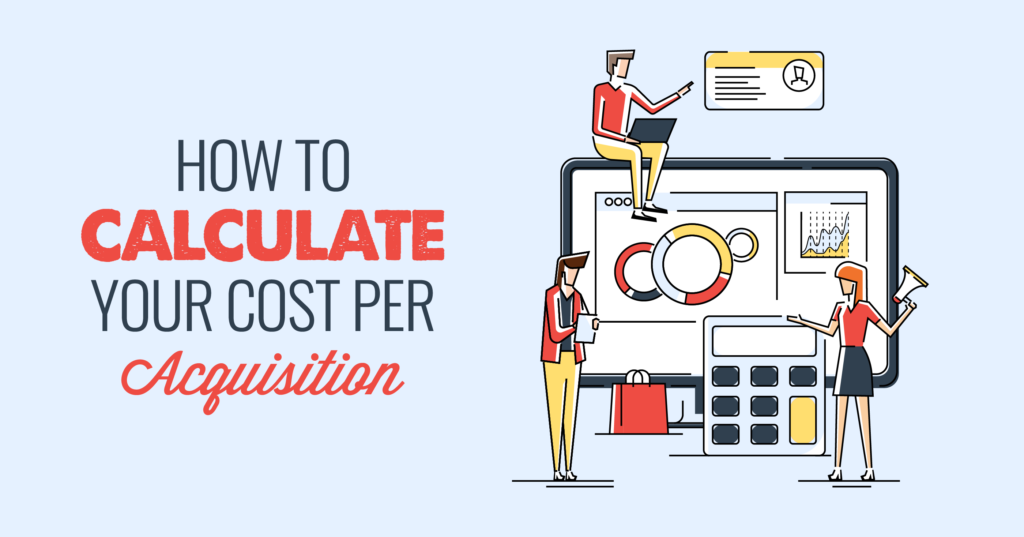
Cost per acquisition is how much you spend to acquire a new customer. It’s a granular metric that focuses on a specific campaign or channel. Unlike CPC or CPI, CPA is about the full journey from first contact to sale.
CPA might sound pretty similar to customer acquisition cost, but they’re not the same thing. Your cost per acquisition is how much you spend to acquire a new customer through a specific channel (like Facebook ads), while customer acquisition cost is your across-the-board cost for acquiring customers across all channels.
Calculating your CPA is easier than you might think. First, figure out your total marketing costs spent on a specific channel/campaign. Then, divide your costs by the number of new customers acquired from the same channel/campaign. Simple enough, right?
[highlight]Here’s the not-so-simple part: You need to know how many customers come from every channel and campaign to calculate an accurate CPA. That means you need to track where every single lead comes from (and invest in lead tracking software to get the job done right).[/highlight]
Why? If you don’t know which channels convert, you’re only going to drain your budget on ineffective channels that don’t drive results. Maybe your gut feelings are keeping your appointment book full, but they’re not going to steer you in the right direction forever.
At the end of the day, you need to know exactly what’s going on with your marketing strategy to pave the best path forward—and you can’t get a full picture without the right data.
You’ve calculated your CPA, but what does that number mean? A “good” CPA looks different for every company, but let’s start out with some numbers. Across all industries, the average CPA for PPC ads is $59.18, while the average CPA for display is slightly higher at $60.76.
Every business is different, and your CPA is going to be different from the competition (yes, even if you sell the same services). Your CPA depends on a few factors, including your services, marketing strategy, and how many customers you have. For most contractors, CPA is cyclical, meaning it increases during shoulder season and decreases during peak season.
Think about it: If you’re a home builder, you need to do a lot more convincing to persuade prospects to hire you. They’re making a major investment, so you’re going to need a standout PPC campaign to draw them in. Meanwhile, if you’re marketing residential power washing or plumbing services, you’ll probably spend a fraction of the cost to acquire a new customer.
So, how can you benchmark your CPA? See how it stacks up against another internal benchmark—your customer lifetime value (LTV).
Your CPA should be relative to your LTV. When your LTV is higher, you’ll have more room to spend on acquisition because your average customer will spend more than the cost of acquiring them. In other words, you can spend more money on bold PPC strategies to keep business flowing.
How does Google determine which ads show up where? It’s simple. Google wants to incentivize the best advertisers to advertise the best content on their search engine results pages, so they reward ads with high quality scores, higher ad rankings, and lower CPA.
That means your quality score, which measures the quality of your content, can be your MVP when it comes to ad rankings. A higher quality score can land you top ad rankings, which can help you win more conversions and optimize your CPA.
So, how can you step out in front of the competition with killer content? Here’s how to boost your quality score and score top ad rankings.
Remember: CPA is a granular metric, and it’s also important to track other marketing metrics to get an accurate picture of your ROI. By maintaining a consistent cadence on metric tracking, you’ll start noticing patterns around when metrics change—and the factors that cause those changes.
Especially for contractors, it’s normal for CPA to fluctuate depending on the month or season. If it’s lower in the summer, for example, it might be time to ramp up your PPC campaigns. This way, you’ll be able to acquire new customers, retain them, and set them up in time for holiday promos.
Ready to brainstorm your action plan? Reach out to our team to grow your contractor business and ignite your ROI with expert PPC strategies.