
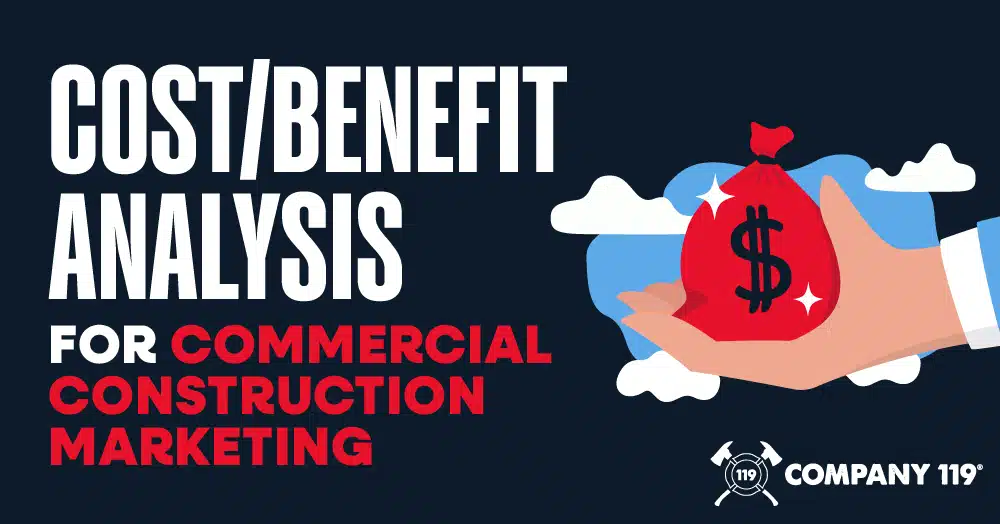
Marketing isn’t cheap. Whether you’re paying for digital ads, printing yard signs, or investing in a shiny new website, every dollar counts. And in the construction world, where margins can be tight and time is money, there’s no room for guesswork when it comes to your marketing budget.
So, how do you know if what you’re spending is working? That’s where cost/benefit analysis comes in. It’s not just about getting more leads or racking up likes—it’s about seeing real results that actually boost your bottom line. After all, if you can’t tie your construction marketing efforts to actual revenue or project wins, you’re throwing darts in the dark.
We’re here to break down how to measure the return on your marketing investment (ROI) and, more importantly, how to turn that data into smarter, more profitable decisions. Here’s how to get the most bang for your buck by tracking what’s working, cutting what’s not, and making every marketing dollar pull its weight.
Marketing for construction companies isn’t just about visibility; it’s about driving tangible results. Whether you’re bidding for residential remodels or large-scale commercial jobs, every marketing dollar needs to contribute to real business growth. Without understanding your return on investment (ROI), you’re essentially throwing money at tactics and hoping something sticks. That’s not a strategy—it’s a gamble.
ROI gives you a clear picture of what’s working and what’s not. In turn, you can double down on the campaigns bringing in qualified leads and cut the ones that are draining your budget. In a competitive industry where trust, timing, and precision matter, tracking ROI helps you stay agile and efficient with your construction marketing. Remember: It’s not just about spending less, but spending smarter.
To evaluate ROI accurately, you’ll need to factor in all your marketing costs—not just the obvious ones. Here’s a list to help you account for the full picture:
To really know what’s driving results, you need to track where your leads are coming from and what happens after they reach out. It starts with asking every new lead, “How did you hear about us?” But that’s just the baseline. You should also be using tools like call tracking numbers, unique landing pages, and Google Analytics to follow a lead’s journey from first click to signed contract.
Once a lead is in the system, track their progress. Did they request a quote? Did they book a consultation? Did they convert into a paying customer? You can use a customer relationship management (CRM) tool, a spreadsheet, or even project management software to track this data. The key is consistency. The more you know about how leads are moving through your funnel, the better you can fine-tune your marketing for higher conversion rates.
Here’s a simple formula to calculate your marketing ROI:
(Revenue generated from marketing – Marketing costs) ÷ Marketing costs = ROI
Let’s say you spent $5,000 on a local SEO campaign over three months and landed four projects that brought in $25,000 in revenue. Your calculation would look like this:
($25,000 – $5,000) ÷ $5,000 = 4, or 400% ROI
That means for every dollar you spent, you earned four dollars back. This formula can be applied across individual campaigns, platforms, or your entire AEC marketing strategy. Just remember—your revenue numbers should reflect actual closed deals, not just inquiries. Focus on what truly moved the needle.
Once you’ve crunched the numbers and figured out what’s giving you the best return, the real power comes in what you do next. For commercial contractors, marketing isn’t just a one-and-done effort. Instead, it’s a cycle of testing, measuring, adjusting, and improving. The more regularly you evaluate your performance, the more confident you’ll be in where your money’s going. That means fewer wasted dollars and more high-quality leads.
Here’s a checklist to help you keep your AEC marketing efforts sharp and ROI-focused:
Understanding the ROI of your marketing efforts is essential for construction contractors to stay competitive and grow their businesses. By regularly evaluating your campaigns, testing new strategies, and focusing on what actually drives results, you can make smarter marketing decisions that impact your bottom line.
Not sure where to start? Our free Marketing Audit Checklist for Contractors helps you evaluate the strengths and gaps in your current strategy—so you can get clear on what’s working and what needs work.
Ready to step up your marketing game? At Company 119, we specialize in marketing for construction companies that deliver measurable results. Let’s work together to build a strategy that works as hard as you do. Reach out today to get started.