
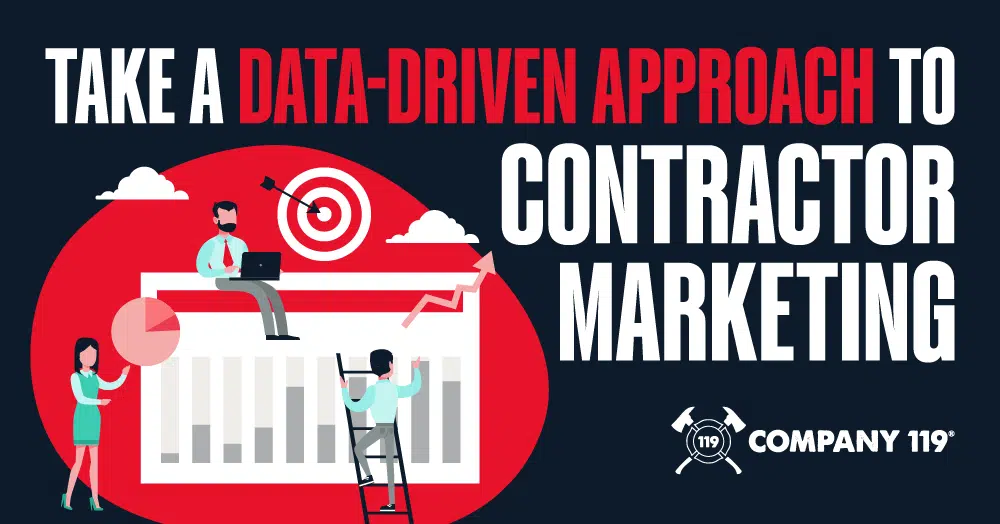
When you’re running a business, every dollar counts. You’re investing in marketing, lead generation, and operations—but how do you know if it’s all actually paying off? That’s where analytics come in.
Tracking your return on investment (ROI) isn’t just about looking at your bank account at the end of the month. It’s about understanding which marketing efforts bring in high-value leads, which projects drive the best profit margins, and where you might be wasting money. With data-driven insights and key performance indicator (KPI) tracking at your side, you can sharpen your manufacturer marketing strategy and stay on track for long-term growth.
At Company 119, data-driven insights aren’t just buzzwords—they’re the foundation of smarter marketing. By continuously analyzing campaign performance, lead conversions, and project profitability, our experts help contractors make informed decisions that maximize ROI. So, how can you use analytics to track and improve your own ROI? Let’s break it down.
Running a successful business isn’t just about winning jobs; it’s about making sure those jobs are actually profitable. That’s where ROI comes in. ROI helps you measure the effectiveness of your spending, whether it’s on marketing, equipment, or labor. And if you’re not tracking it, you could be pouring money into efforts that don’t deliver results.
By understanding and optimizing ROI, contractors can:
To measure ROI effectively, you’ll need to track the right KPIs. These metrics provide a clear picture of what’s working, what’s not, and where to adjust your strategy for better profitability. Here are the most important KPIs every contractor should monitor:
Your lead conversion rate measures how many of your leads turn into actual paying customers. A low conversion rate could indicate issues with your sales process, pricing, or targeting.
This KPI tells you how much you’re spending to acquire each potential customer. A high CPL could mean you need to refine your marketing strategy or optimize ad spending.
CAC tracks the total cost of turning a lead into a paying customer, including marketing, sales, and operational costs.
Not all jobs are equally profitable. Tracking profitability by project helps you identify which types of work yield the best ROI.
Tracking revenue growth over time shows whether your business is expanding or stagnating.
CLV estimates the total revenue a single customer will bring to your business over time. A high CLV means you’re keeping customers engaged and maximizing repeat business.
This KPI measures how much revenue your marketing efforts generate compared to what you spend.
Generating leads is one thing, but converting them into paying customers is another. With the right analytics, you can track where your leads are coming from, which marketing channels perform best, and how many inquiries turn into actual jobs. Tools like Google Analytics, CRM software, and call tracking can help measure lead sources and customer interactions, giving you valuable insights into your sales funnel.
Of course, tracking conversion rates is just as important. If you’re getting plenty of leads but not closing deals, the issue could be your sales process, pricing, or response time. When you analyze key data points—such as website traffic, form submissions, and follow-up response rates—you can identify bottlenecks and optimize your approach to turn more prospects into clients.
By staying on top of lead generation and conversion analytics, you can refine your marketing strategies, improve customer engagement, and increase ROI. Small tweaks—like adjusting ad targeting, improving website call-to-action buttons, or following up with leads faster—can make all the difference in closing more deals and scaling your business.
As we mentioned before, measuring marketing ROI is essential to make sure you’re getting the most out of your advertising budget. The basic formula is (Revenue from Marketing – Marketing Cost) ÷ Marketing Cost × 100, which gives you a clear percentage of how much return you’re generating from your efforts. But tracking ROI goes beyond just crunching numbers—it’s all about understanding which strategies bring in high-value leads and which ones need improvement.
To get an accurate picture, it’s important to track multiple factors, including lead sources, conversion rates, customer acquisition costs, and lifetime value. At the same time, breaking down ROI by marketing channels—such as paid ads, social media, or SEO—can help you identify the most cost-effective ways to attract new clients.
With a clear understanding of your marketing ROI, you can focus on the highest-performing channels, reduce wasted spend, and maximize profitability. Whether it’s optimizing paid ads, improving SEO, or fine-tuning email campaigns, data-driven marketing strategies help grow your business efficiently while giving you the peace of mind that every marketing dollar is well spent.
At Company 119, we leverage data to guide decisions crucial for long-term success. Our experts are dedicated to helping contractors continually optimize their marketing strategies to drive real, measurable results.
With tailored digital strategy roadmaps, we guide you every step of the way. Our team helps you define clear objectives, identify the most effective channels, and develop actionable plans to achieve your business goals. Whether you’re looking to fine-tune your lead generation, improve conversion rates, or maximize your contractor marketing ROI, we’re here to support you in making data-driven decisions that propel your business forward. Contact us today to get started!