
When you’re running an auto shop, one thing is certain: You can’t afford to ignore digital marketing. Your customers are searching online for local businesses more than ever, with 97 percent of consumers learning about local companies online. That’s why you need a scalable marketing strategy to keep your appointment book full.
Maybe you’re already running PPC ads for your primary location, or you’re thinking about opening a few more shops across town. If you’re operating multiple locations or serving multiple cities, multi-location marketing can be your MVP.
Even if you’re not a marketing pro, multi-location marketing can take your shop to the next level. It’s the tool you need to win more business, keep the phone ringing, and get in front of the right people at the right time. So, what are you waiting for? Here’s how to win more business with an effective multi-location strategy.
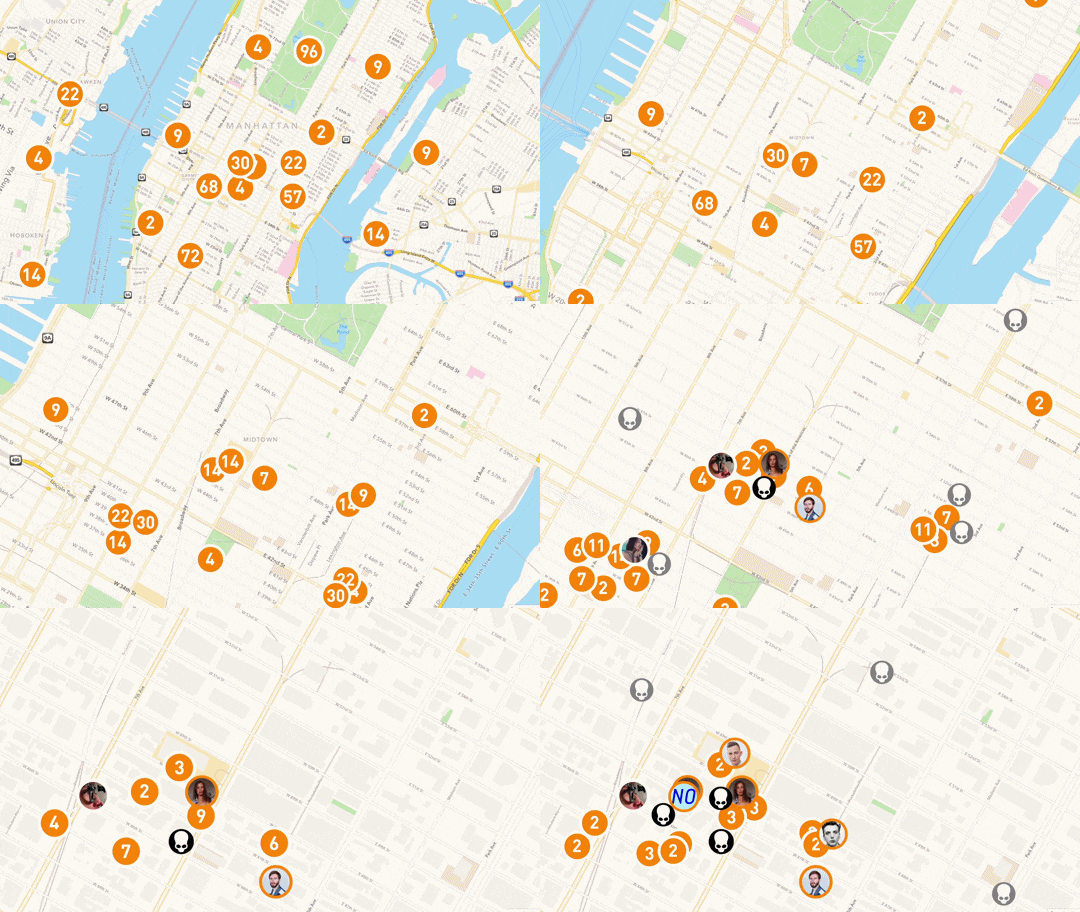
First things first: What exactly is multi-location marketing? And how is it any different from traditional single-location marketing? It might sound like a trick question, but multi-location marketing isn’t just about marketing more storefronts.
When you have multiple locations, there are a few things to consider. Do all of your shops offer the same services? Do they sell the same products? Do you only offer specific services at one location? Are your shops spread out from city to city or across town?
You’ll need to answer these questions to build the best foundation for your multi-location strategy. Then, with the right strategy in place, you’ll be able to sell more of your preferred services at each location.
At the end of the day, you need a digital marketing solution that caters to every single one of your shops—not just your most popular location. This way, you’ll ensure that each location gets the attention it deserves, along with the online visibility it needs to capture new auto repair leads.

The first step to multi-location marketing? Step up your content marketing game. You need landing pages for every location—and they need to be unique. We know that it’s tempting, but you can’t just copy and paste the same content for every location.
When you’re writing location pages for your shop, your content needs to be engaging, relevant, and valuable. You need to write for your customers, and you need to use the right keywords to get in front of the right people.
What should your keyword strategy look like? First, your location pages should list your products and services. Next, you need to target your audience using location keywords. Now, keep this in mind: If you create cookie-cutter location pages with copy-and-paste content but swap out the location name, Google is going to penalize you for having duplicate content on your website.
Sure, you’re targeting a different audience because you’re using different location keywords, but the vast majority of your content is similar (or exactly the same). So, instead of copying the same information across every page, you need to create specific pages for each location.
Your location pages should open with a brief introduction about the location, outline your services, and conclude with what’s unique to that location. If you already have a “home location” page, use it as a reference for your products and services. This way, your customers will know what to expect at your other locations, but you won’t have to duplicate content across every location page.
Let’s take Rad Air, a locally owned and family-operated auto shop with locations across Northeast Ohio, as an example. Over the past six years, Company 119 has partnered with Rad Air to reach more customers and book more appointments. Using a simple zip code built into Rad Air’s website, prospective customers can quickly find the closest Rad Air location.
Each location has a customized landing page that provides key information, such as location hours, directories, as well as a click-to-call phone number, and an online booking system—all of which fuel conversions for Rad Air. Combined with a highly targeted marketing strategy, Rad Air’s location pages allow the company to maintain its competitive edge in the Greater Cleveland and Akron auto repair industry.
You’re probably already using a Google Business Profile for your primary location, but what about your secondary locations? If you want to drive leads across every location, you’re going to need a Google Business Profile for every location.
Why? When it comes to auto repair marketing, local search matters. When you set up profiles for every location, you’re making things as easy as possible for your customers. This way, they can book appointments without scouring your website to find the closest location to their house.
No matter where a customer is, they should be able to find your closest shop with a quick Google search. Then, they can call the right location or book an appointment online with a few clicks. Sounds simple enough, right?
What’s the secret to successful multi-city marketing? One word: consistency. If you’re listing your businesses on lead generation sites, social media, or other listing websites (hint: you should be), you’ll need to share the same information across every single listing.
This is especially important for auto repair shops with longer names. Before launching your marketing strategy, double-check that your business name is consistent across every listing. Even a minor difference can leave potential customers questioning if it’s the same business. And sometimes, that might just be the push that sends a lead to the competition.
When you’re consistent, you highlight your professionalism and reliability—and that can make all the difference to potential customers. No matter where your customers are, they’ll be able to find the location they’re searching for.
Of course, consistency doesn’t end there. You also need consistent contact information so your customers can reach the right location when they pick up the phone. Avoid listing multiple phone numbers for your business—it’ll only confuse potential customers. If each of your locations has a different contact number, use the right number across every listing.
Now that you’ve mastered the art of multi-city content marketing and local search, it’s time to move on to pay-per-click (PPC) marketing. When you’re running campaigns for multiple locations, you have a much wider customer base. So, to avoid missing out on any leads, you’ll need to create local PPC ads targeting each location.
Don’t worry, multi-location PPC marketing isn’t as complicated as it sounds. You can keep the same general template across your ad campaigns, but you’ll need to use geotargeting to serve ads to searchers based on their geographic location. Of course, you’ll want to tweak your ad copy and targeting options to target the right location keywords.
To top it off, your landing pages should feature location-specific language. As soon as they click on your ad, you want to show prospects that they’ve reached the right place for their specific location. This can be as simple as a heading at the top of your landing page, like Brake Repair in Cleveland.
If you already have email and SMS marketing campaigns in place, you’re on the right path. With email and SMS, it’s easy to send information about your company as a whole—whether you’re running promotions, sharing general updates, or retargeting lost leads. Not only that, but emails also have an incredible open rate, with 99 percent of people checking their inbox every single day.
Now, what if you could send email blasts to customers within a specific location? Maybe you’re offering a special promo on oil changes at your downtown shop, or you’re trying to sell more tire services to use up extra parts at your uptown shop. That’s where segmentation can be a game-changer for your multi-location strategy.
In a nutshell, segmentation divides your email/SMS subscribers into smaller audience segments based on set criteria, like their geographic location. You can group customers based on location identifiers, such as their city, postal code, or even their preferred shop location.
Our clients tell us that segmentation is one of the best ways to personalize their email campaigns. Plus, segmentation leads to better ROI—and the numbers back this up. According to HubSpot research, marketers who segmented email campaigns noted as much as a 760 percent increase in revenue (yes, you read that right).
Think about it: When you segment your audience based on location, you can reach the right people at the right time. You’re regularly getting in front of your audience with ultra-relevant content, so you’re always top of mind.

Even if you’re the best shop in town, your customers aren’t going to spend hours scouring the internet to find a location near them. After all, they can afford to be picky. They want to find the best deals at the nearest locations with the highest rating, and they have all the information they could ever possibly need at their fingertips.
You need to run toward the fire to keep up in today’s digital world. Small businesses aren’t the only ones who need a winning marketing strategy to survive—automotive repair shops need one, too.
When you’re ready to start brainstorming your multi-location strategy, we’re here to help. Contact us today to kick your marketing plan into high gear.