
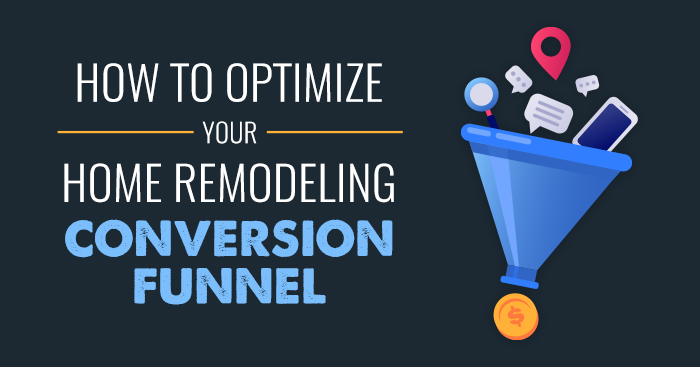
In any industry, successful marketing starts and ends with a powerful website funnel. Sure, spending a day canvassing in your service area or handing out business cards might reel in a few leads, but traditional marketing techniques aren’t going to provide sustainable, steady business you can rely on. A conversion funnel focuses on building relationships with potential customers—without ever meeting them. It’s about promoting your brand and keeping your business in the minds of local homeowners.
At the end of the day, a powerful conversion funnel maximizes the profit you get from your digital marketing campaigns. And if you have a home remodeling website, we have good news: You already have a funnel in action. Maybe it’s not getting the results you want just yet, but it’s there.
In fact, if you’re trying to get website visitors to take action—whether that’s signing up for SMS marketing messages or requesting a quote—you have a funnel. Nearly every website has some kind of funnel, but 78 percent of businesses aren’t satisfied with their conversion rates.
So, how can you optimize your home remodeling website conversion funnel to seamlessly guide customers through the buying journey? Are your landing pages and calls to action really that important when it comes to conversions? Here’s how to optimize your website funnel so you can stop losing sleep over lost leads.
A conversion funnel is the buying process a homeowner goes through before they’re ready to hire your company. In other words, it’s the journey leads take before they become paying customers. These leads can be generated through countless methods, from search engine optimization to paid ads.
If you can visualize and understand this process, you’re already on the right track to optimizing your funnel. Here are the four steps that local homeowners are going to take before they pay for your services:
Now that you’re a pro at the basics, let’s dissect the customer buying journey so we can see exactly what you need to do at each step:
To guide customers through their buying journey, you need to pull leads into the top end of your funnel. This is where your brand awareness strategy can have a dramatic impact. Think about it: Local homeowners are going to research home remodeling companies before making a decision, and they can’t hire your company if they don’t even know you exist.
This component of your marketing strategy encompasses anything that gets your brand noticed by potential customers. There are countless ways to raise brand awareness, but not every channel is created equal. Some of the best channels for home remodeling companies include:
When crafting the perfect campaigns, it might be tempting to cast a wide net and get your name in front of as many people as possible—but this is only going to send your time, money, and marketing efforts straight down the drain. You don’t want to waste precious marketing dollars advertising to teenagers or other people outside your target audience who aren’t going to pay for your remodeling services or even visit your website.
Avoid sacrificing time and money for unqualified leads by honing in on your target audience. With lead generation, quality is always more important than quantity.
Now that prospects know that you exist, you need to make them interested in your renovation services. And, as we mentioned earlier, your website is one of the best tools for the job.
To start optimizing your website, figure out exactly what questions local homeowners are asking about your services. Maybe clients constantly ask you how long their projects are going to take—or they’re wondering what materials are best for stretching their budget. Discover what questions your customers are asking, and then create engaging, informative, valuable content that provides the answers they’re looking for.
For the best results, try crafting different types of content. Write blog posts, publish in-depth guides, create shareable infographics, and post videos. Your end goal is to give interested customers a better understanding of what you’re offering—and why your company is better than the local competition.
Content is an important piece of the puzzle, but to convert leads, you need to take it one step further. One of the best tools for conversion is downloadable content. Create worthwhile downloadable resources—like pricing guides or infographics on the top homeowner projects of the year—and then ask website visitors to take action. To download the content, they’re going to need to enter their email address.
Once you’ve scored their email address, you can send them more valuable content, promotions, or seasonal reminders, guiding them further down the funnel. Your resources highlight the value you provide, set your business apart from the competition, and keep your brand at the top of homeowners’ minds. This way, when they’re ready to take on that renovation project, you’ll be the first one they think of.
Next, you’ll need to show leads exactly why they need your services. Start sending out emails and creating drip campaigns with the value you provide. Email marketing gives you the perfect opportunity to strengthen the relationship between your brand and potential customers.
Your success will boil down to your ability to offer effective solutions to your customers’ problems. Touch on some specific problems you can solve—are your customers sick of dealing with dingy, old tile floors that take forever to clean? Is their kitchen too small to store all of their pots and pans?
Then, focus on how your solution is different from the competition. Maybe you’ve spent years working on custom kitchen remodeling projects or you have certifications that your competitors don’t. Once you show leads what sets your company apart, converting those leads into appointments is going to be much easier.
The last stage of the customer buying journey involves getting your customers to take action. Sure, your customers might have taken some action already, like downloading that infographic or clicking on the links in your text messages. Now, you want them to buy your services.
This is where you close the leads that need home remodeling projects done. To encourage customers to take action, you might tempt them with a promotion or special. For example, you might offer discounted crown molding to first-time customers or throw in some promotions on spring/fall maintenance. Either way, you want to give your leads something that will reel them in for good without any second-guessing.
Only a fraction of those prospects at the awareness stage are going to make it to the bottom of the funnel. But when you take steps to optimize your conversion funnel, you can boost your conversion rate by maximizing the number of leads that ultimately take action. This way, you can get the most out of your marketing efforts and avoid sacrificing your time and money on leads that aren’t going to convert.
Creating a powerful website conversion funnel can make your conversion rates soar, but it’s not going to happen overnight. With that said, if you want to maximize your ROI and get more sales, you need to start working on your conversion funnel.
Here’s how to improve your funnel so you can start converting more website visitors into qualified leads—and more leads into appointments:
The stages we discussed above aren’t the only stages of a conversion funnel. Depending on what steps you want your customers to take, your conversion funnel might be much more complicated. You might even have multiple actions that you want customers to take.
To upgrade your funnel, take a step back and consider your customers’ buying experience. You’ll want to analyze how visitors search for your services and navigate your website. Then, you can maximize the leads that land at the bottom of the funnel.
Most importantly, you want to consider what steps visitors take between clicking on your website and hiring your company. Chances are, most visitors click on your site, check out your landing pages, look at your portfolio, and fill out a form, right?
As you develop your conversion funnel, remember that you’re mapping out a typical customer journey across your website. Of course, not every website visitor is going to take this path. Along the way, potential customers might check out your company’s “About” page, review some of your blog content, or enter their email addresses to download informational resources.
“All customers who convert on a website go through the same funnel, but they take different paths down the funnel at different speeds because of where they are at in their journey and what they need to progress further down the funnel,” says John J. Antognoli, Senior Client Advisor at Company 119.
Try to map out a few different paths. You won’t be able to develop separate funnels for every single customer journey through your website, and that’s OK. The more of them you can account for, the better you’ll be able to understand how visitors become customers.
“Start with the assumption that every customer has some sort of need, and that is how your brand got their attention,” says Antognoli. “That is the awareness component that brings your customers into the funnel.”
From there, some customers may not need any additional information from your brand. They pass right through the “consideration” phase of the funnel and are ready to sign a contract. Others, however, will need reassurance that they are getting the best deal, that your home remodeling company has a great reputation, and so on. And as they check off box after box, they will move past consideration into the “action” phase.
At this point, still, customers take action differently. Some might not want to submit an online quote request form and instead wait to talk to one of your team members and ask a few questions. Others have no interest in chatting and would rather schedule a consultation as quickly as possible.
“Understanding the funnel and the different customer paths is more of a breakdown of each stage and an analysis of what the various needs are in each one that a consumer might need or want,” says Antognoli. “Playing out each of these scenarios helps you identify the paths of your website these customers might take and at this point you can begin to optimize them.”
After mapping out a few customer journeys, you’ll need a reliable way to measure how visitors are actually navigating your website. Here’s where Google Analytics changes the game.
If you’re not using Analytics yet, this is your sign to start. It’s one of the best tools to monitor your site’s performance. To get an accurate idea of how your funnel is performing, create goals at every stage of the funnel. At the very least, you should be setting up four goals—one for each stage. You should also create goals for every major conversion, from content downloads to quote requests.
With every new goal you add to your site, assign it to a portion of the funnel that best corresponds with where a consumer is at. And when you want to understand more about any one of those stages, you view only that goal, or set of goals at that point in the funnel, and start looking at patterns: What pages are people leaving the site from? What pages are they spending time on (which could indicate if something is very interesting or, on the flip side, very confusing)?
“This is the beauty of Google Analytics,” says Antognoli. “When you harness the power of the information it provides, you can gain such amazing insights into things you would have never been able to pick up on without it. Like any tool, you just need to know how to use it right.”
Most home services companies invest in strategic landing pages to explain their services and convert more leads. In short, landing pages are destinations on your website where you convince visitors to hire your company. However, even if you have landing pages in place, this isn’t a guarantee that your customers will keep browsing your website.
According to Kissmetrics, the average bounce rate for organic website visitors is 40.5 percent. Prospects might click away from your website for all sorts of reasons—from slow loading times to a boring web template—so you really want to take the time to make a great first impression.
Make sure to keep your website simple, clutter-free, and optimized for mobile devices. Fast loading times are key here, as slow websites cause most customers to lose patience. Website speed can make a huge difference in your conversion rate: 1 in 4 visitors abandon websites that take over 4 seconds to load—and nearly half of visitors who abandon slow-loading websites don’t revisit them.
If your marketing budget allows, it never hurts to invest in professional web development, either. Working with a web development team can transform your website with a professional design, compelling landing pages, and great content creation. Plus, it can help you lower the number of clicks that visitors are expected to make on their journey down the sales funnel.
Valuable content doesn’t just drive organic traffic to your website—it also builds trust and credibility among potential customers. In this way, your web content is a key ingredient of your conversion funnel, moving your leads from the awareness stage further down the funnel.
To turn people browsing the Internet into qualified leads and interested customers, you need to help them learn about your business, address their pain points, and highlight the value in their services. You want to tell them exactly how your services can solve their problems, add value to their lives, and help them achieve their dream home. Web content is a major catalyst here.
As you’re figuring out what topics and what types of content your leads want to see, make sure you’re creating content experiences for every step in your customer’s buying journey, including:
Take a step back and visualize an actual funnel. When you pour liquid through it, everything has to come out somewhere, right? If that’s the case, why are you losing so many leads throughout your website conversion funnel? In most industries, the average conversion rate for contact forms is a bleak one percent.
The truth is that your website conversion funnel has holes. At every stage of the funnel, you’re filtering out users who aren’t interested, and only those who qualify will make it to the next stage. The rest leave your funnel through holes, or “leaks.”
So, are you just supposed to let these leads slip through the cracks? Of course not. Sure, some of your website visitors are leaving the funnel because they’re not qualified leads, but that’s usually not the case. Sometimes, your website just doesn’t do a good enough job to move them down the funnel.
The first step to plugging those leaks is to identify exactly where they are. If you’re using Analytics to monitor funnels, you can use the Funnel Visualization report to reveal any drop-off points. Your report might show you that 5 percent of visitors make it from your blog posts to your landing pages. This shows you exactly where you’re losing visitors—and what steps you can take to strengthen your funnel.
Next, focus your efforts on pages that you’ve identified as leaks. In most cases, these are going to be key players in boosting your conversion rates. If you’re not sure where to start, heatmaps will show you where your visitors are clicking the most. If your visitors are primarily clicking on the top right of your page, for example, you might want to add an email sign-up button in that area. Or, you might optimize your pages with more compelling content and stronger CTAs. Even if it seems like a trivial change, the little things can have a dramatic impact on your bottom line.
With every change you make, you should use A/B testing to monitor your results. With A/B testing, you can run different variations on your “leak” pages to see which generates more conversions. Take it one step at a time, and run each test for at least 2 weeks to get an accurate picture of your site’s performance.
What do you do after customers make it to the bottom of your sales funnel? Imagine a visitor spends two months engaging with your emails, visiting your website to read new blog posts, and following your company on Facebook. Finally, they fill out a contact form, schedule an appointment, and finalize the contract.
Now what? Are you supposed to let them fall out of the funnel? No. After all, it costs 6 to 7 times as much to earn a new customer than it does to retain an existing one. Plus, while the probability of selling your services to a new lead ranges from 5 to 20 percent, the chances you’ll sell to an existing customer ranges from 60 to 70 percent.
When you work with an existing client, it’s that much easier to set proposals, deadlines, and budgets. And you’re already familiar with their goals, so you’re likely to get the job done right. So, how do you convert one-off projects into loyal clients?
Your main goal is to keep customers engaged with your brand. You want to stay at the top of your customers’ minds. Here, email campaigns, SMS marketing, and social media can be extremely valuable assets. With segmented SMS follow-ups, social media promotions, and email reminders, you’re gently reminding your past customers that you’ll be there when you need them. Then, when they’re ready to start their next remodeling project, you’ll be the one they call.
Optimizing your website conversion funnel isn’t easy—and you’re not going to see results overnight. When our clients are willing to go the extra mile and offer an unrivaled customer experience, they stand out from the crowd and get noticed.
When you take the time to understand your customers’ buying journey, you can upgrade your funnel to maximize the number of website visitors that become paying customers. Instead of wasting time, money, and effort advertising to visitors who aren’t ever going to contact you, you can maximize your ROI and convert more qualified leads into appointments.